

🌿 Ainhoa: the picture-postcard village peeking over the border
There are villages that look like movie sets: a single street, white facades with red and green timber framing, geraniums spilling over every balcony, and a silence broken only by the church bells. Ainhoa is exactly that, and it’s just a short drive from Casa Angiz. Founded in the 13th century as a stop for pilgrims on the Camino de Santiago, it is now considered one of the most beautiful villages in France — and very few people visiting Baztán-Bidasoa know it’s so close.
📍 Quick information
| 📌 Location | Ainhoa, Labourd (French Basque Country), France |
| 🚗 Distance from Casa Angiz | About 35-40 minutes by car (~30-35 km) via Dantxarinea or Zugarramurdi |
| 📐 What it is | A single main street (medieval bastide) with Labourd-style architecture, a historic church, and a cemetery with discoid stelae |
| 👨👩👧 Ideal for | Couples, families, photography lovers, and Camino de Santiago enthusiasts |
| 🎯 Best time | Spring and summer (flower-filled balconies), though it’s beautiful all year round |
| ⏱️ Recommended time | 1.5-2 hours for the village; half a day if combined with Sara or Espelette |
| 🌐 Official website | xareta.eus |
🎯 What to see and do in Ainhoa
- 🏘️ The main street (Karrika Nagusia): the heart of the village, a single avenue laid out in the 13th century when Premonstratensian monks founded Ainhoa as a bastide to host pilgrims.
- ⛪ Notre-Dame-de-l'Assomption Church: from the 13th century, with a pillarless nave, wooden ceiling, and interior galleries carved in 1649. Its square tower, topped in the 19th century with an octagonal section and slate spire, can be seen from the whole street.
- 🪦 The cemetery and its discoid stelae: next to the church, a small graveyard preserves hilarriak (Basque discoid stelae) from the 16th and 17th centuries, carved with geometric and solar symbols. One of the village’s most photographed postcard views.

🏘️ The main street, heart of the village

⛪ The Notre-Dame-de-l'Assomption Church
🪦 Basque discoid stelae (hilarriak) in the cemetery next to the church
- 🏡 Labourd-style architecture: whitewashed houses with timber framing painted ox-blood red or green, and lintels with the year of construction, the owner’s name, and hand-carved religious symbols.
- 🥾 The Camino de Santiago (Baztan route): for centuries, Ainhoa was an obligatory stop for pilgrims crossing toward Urdazubi-Urdax and Baztán. Even today, you can walk part of this historic route.
- 🧀 Pierre Oteiza’s shop: next to the tourist office, the best place to pick up Kintoa ham, chistorra, or artisanal sheep’s cheese from the French Basque Country.
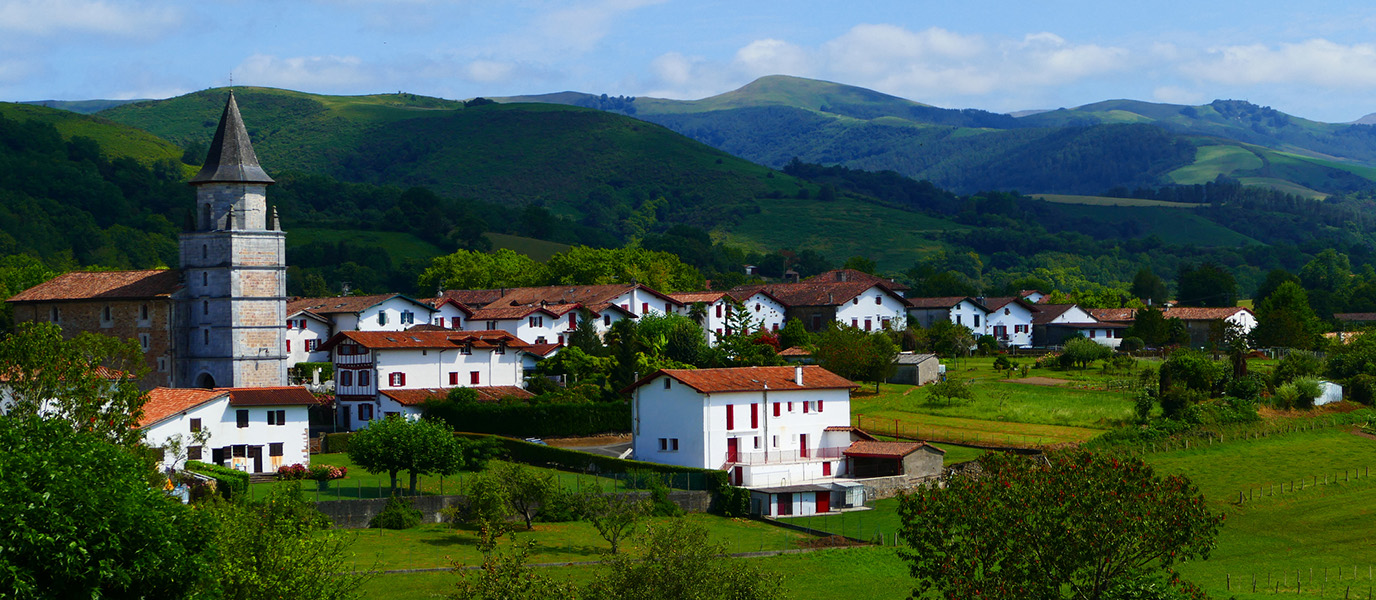
🏡 Facades in Labourd style, with hand-painted timber framing
- 🔥 A history of fire and rebuilding: in 1629, during the Thirty Years’ War, Spanish troops burned down almost the entire village. Only the church and the Matxitorenea house survived — the rest of the Ainhoa we admire today was rebuilt afterward.
- 📸 Photo spots: flower-filled balconies, carved wooden doorways, and, at the end of the street, the mountains of La Rhune rising between the rooftops.
🏔️ La Rhune peeking in the distance, seen from the outskirts of the village
🗺️ The jewel of a shared territory: Ainhoa and the Xareta Valley
Ainhoa is part, together with Zugarramurdi, Urdazubi-Urdax and Sara, of the so-called Xareta Valley, a historic territory split between Spain and France that we already covered in detail in our article about the Xareta Valley. If you already know the Zugarramurdi Caves, Ainhoa is the perfect excursion to round out the day: same territory, two countries, one invisible border.
👣 Our experience in Ainhoa
For years we’ve been recommending Ainhoa to guests staying at Casa Angiz who are looking for “something different” for an afternoon. The first time we went, we didn’t expect a village with just one street to keep us entertained so long: between photographing every facade, browsing Pierre Oteiza’s shop, and sitting on a terrace for a drink, the whole afternoon slipped away. It’s one of those places where there’s no big “plan” — you simply stroll, look up, and enjoy the silence.
🚩 The calvary at the village exit, with views over the valley — a great way to end the visit
🍽️ Where to eat in Ainhoa and nearby
- 🧑🍳 Terraces on the main street: several bars and restaurants with terraces where you can try simple French-Basque cuisine.
- 🥖 Basque cake: don’t leave without trying gâteau basque, typical of the whole Labourd area.
- 🧀 Pierre Oteiza shop: to take home ham, chistorra, or artisanal cheese.
- 🍷 If you stay longer, Espelette (famous for its pepper) and Sara are only 10-15 minutes away and make for another great food stop.
🏡 Your perfect base: stay at Casa Angiz
- 🚗 Less than 40 minutes away you have Ainhoa, Zugarramurdi, the Xareta Valley, and the whole Navarre-French border area.
- 🌳 Casa Angiz is in Sunbilla, in the heart of the Baztán-Bidasoa countryside, ideal as a base for exploring both sides of the border.
- 🛏️ Comfortable rooms and shared spaces designed to help you unwind after a day trip.
- 🍳 Homemade breakfast with local products to start the day right before crossing into France.
- 👨👩👧👦 Suitable both for couples looking for a romantic getaway and for families with children.
- 🌱 Committed to sustainable, local tourism throughout the valley.
- 📅 Easy to combine with other plans in the area: Xareta, Elizondo, the Bidasoa River, or the Bidasoa Greenway.
🌿 Discover Casa Angiz 📅 See rates and book
❓ Frequently asked questions about Ainhoa
How long does it take from Casa Angiz to Ainhoa?
About 35-40 minutes by car, crossing the border via Dantxarinea or Zugarramurdi.
Do you need a passport or anything special to cross into France?
No, since both countries are in the Schengen area, a valid ID card is enough.
Is it a good plan to go with children?
Yes, it’s a short, flat walk, perfect to combine with other family activities such as the Leurtza Reservoir.
How much time do you need to visit Ainhoa?
1.5-2 hours is enough for the village; if you combine it with Zugarramurdi or Sara, allow half a day.
Do you have to pay entrance or parking fees?
No, access to the village and the walk are free; parking in the designated area is free too.
What is the best time to go?
Spring and summer, when the balconies are in bloom, although the village is beautiful all year and there are fewer crowds in autumn.
Can you eat well in Ainhoa?
Yes, there are several terraces and restaurants on the main street serving French-Basque cuisine.


