🌿 The Smugglers’ Route: the paths that linked hunger and the border
Every mountain surrounding Casa Angiz has a second story beneath the tourist one: that of the neighbors who, for much of the 20th century, crossed those same peaks at night, carrying loads, so their families could eat.
When you walk today through Etxalar, go up to the Otsondo pass, or wander around Zugarramurdi, it is easy not to notice that you are literally stepping on the same trails that several generations of smugglers used to move goods —and, in the hardest years, people— between Navarre and the French Basque Country. This is not a route in the sense of a single signposted path from start to finish, but rather a network of trails, mountain passes, and witness villages that can now be explored in sections, at leisure, or all at once if you dare to tackle the full route.
| 📍 Location | Network of trails and mountain passes in Baztán-Bidasoa and the Xareta Valley, on both sides of the border between Navarre and the French Basque Country |
| 🚗 From Casa Angiz | The first sections start 10-20 minutes away (Etxalar, Zugarramurdi, Elizondo); if you want to tackle the full crossing (Kontrabandistak Bidea), the usual starting point is Hondarribia |
| 🧭 What it includes | Otsondo, Lizarrieta and Ibardin passes, the trails of Etxalar, Amaiur, Irurita and Elizondo, and the stretch through the Xareta Valley that you already know from Ainhoa and Sare |
| 👨👩👧 Ideal for | Anyone looking for a short, well-marked walk; experienced hikers if they feel like taking on the full multi-day crossing |
| 📅 Best time | From April to November; the mountain passes may have snow or ice in winter |
| 🥾 Difficulty | Very variable: from a flat one-hour walk to a 7-stage trek of more than 150 km with significant elevation gain |
| 🌐 More info | Kontrabandistak Bidea — official Bidasoa trail |
🎯 Ways to experience the Smugglers’ Route
🥾 The short version: the Blue Horse Route through the Xareta Valley
If you just want to get a taste of the subject without committing the whole day, the most accessible stretch is the one we already told you about in the article on Sare: the "Balade des Pottoks Bleus," which links Ainhoa, Sare, Zugarramurdi and Urdazubi-Urdax on foot, crossing the border several times almost without noticing. It is exactly the kind of crossing used by the smugglers of the Xareta Valley.


🏔️ The Otsondo pass, viewpoint and natural border of the valley
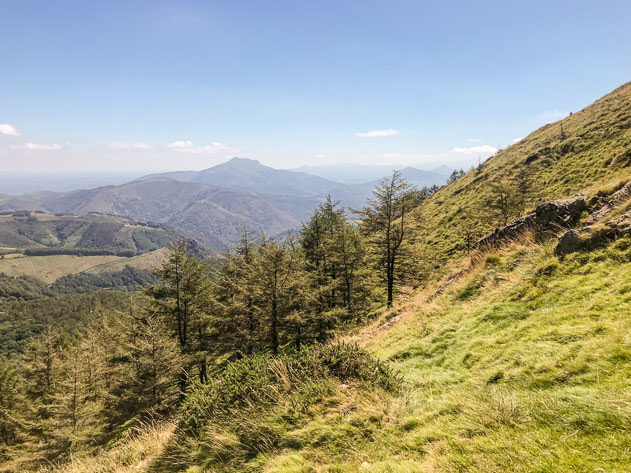
Before there was an asphalt road, Otsondo was already the obligatory crossing between the interior of Baztan and the Bidasoa side. Today you can drive across it in five minutes, but it is worth stopping at the viewpoint: from there, you immediately understand why this area was smuggling territory for generations.
🇫🇷 The Lizarrieta and Ibardin passes, on the way to Sare and Dantxarinea
To the north, the passes of Lizarrieta and Ibardin served the same function as Otsondo, but already crossing into France. Today Ibardin is mainly known for its shops and restaurants, and very nearby, in Dantxarinea, there is still that cross-border commercial traffic —although now legal and with a shopping cart instead of a bundle on the shoulder—.
🥾 The full trek: Kontrabandistak Bidea / Bidasoa Smugglers’ Trail
For those who want to take it seriously, there is a long-distance trek of 7 stages (about 150-176 km depending on the variant) that starts in Hondarribia and passes through, among others, Arantza, Beintza-Labaien, Irurita, Erratzu, Elizondo and Etxalar before closing the loop. It crosses protected natural areas such as the Txingudi wetlands, Aiako Harria Natural Park and the Belate SCI, passing near peaks such as Mendaur.
🏘️ Etxalar, the village most closely linked to this story
Of all the villages in the valley, Etxalar is probably the one most associated with smuggling: its mountains were the scene of cross-border smuggling during much of the 20th century. Walking through its streets, with heraldic houses and wooden balconies, is also walking through that memory.

🐦 The palomeras: another border and mountain tradition
Etxalar and Sare share more than the history of smuggling: they also share the traditional hunting of wood pigeons "en pantalla," with nets and wooden discs, on the same peaks that once served to move goods. It takes place between late September and mid-November, when the pigeons cross the Pyrenees on their migration south.
🕯️ What was really smuggled (and how it was hidden)
Between 1940 and 1970 especially, smuggling in Baztán-Bidasoa stopped being a luxury business and became pure survival: bread, sugar, clothing, lace and coffee crossed the border hidden in a thousand ways. Coffee, those who lived it say, was one of the trickiest products to carry: its smell could give away the person carrying it long before the Civil Guard could be seen.
The methods were as ingenious as they were desperate: shoe soles carved upside down, or shaped like a cow’s hoof, to mislead anyone about the direction of travel; false bottoms in cars and carts; entire herds of legitimate livestock used to camouflage illegal cargo. The farmhouses right on the border line, with one door in each country, did the rest.
Casa Angiz is at the heart of this territory, and it is no coincidence that in Baztan-Bidasoa excursions are still organized to recreate that memory: the article Lan Gaua de Contrabandistas, which we wrote at the time, explains what that "night of work" was like —and in part still is—, now turned into a popular night walk. It is worth checking the dates of each edition before signing up, because it is not held every year under the same conditions.
👣 Our experience with this route
We like to present it not as "an excursion" but as a thread that connects almost all the villages we already recommend separately. A good one-day plan is to go up to Otsondo, go down to Elizondo or Irurita, have something to eat and return via Etxalar; if the day allows for more, you can extend it to Zugarramurdi or Sare and close the Xareta loop.
What we most like to tell our guests is that this is not a made-up "themed route" for tourists: it is real history, told by real people, and you can hear it in the way they talk about it in the villages of the valley.
🍽️ Where to eat after the walk
Etxalar and Elizondo have a good selection of cider houses and restaurants serving traditional valley cuisine: red beans from Bera, lamb, and in season, wood pigeon prepared in very different ways depending on the house. If the walk ends near Zugarramurdi or Sare, you can also finish with a slice of gâteau basque, as we mentioned in the Sare article.
🌱 A landscape that is preserved because it is cared for
Much of these trails cross private land, inhabited farmhouses and grazing areas. Stay on marked paths, close any gates you find open (or the other way around, depending on how they are), and avoid approaching livestock. It is also hunting terrain during palomera season, so it is advisable to check before heading out on those dates.
🏡 Your perfect base: stay at Casa Angiz
Sunbilla is right in the heart of Baztán-Bidasoa, a stone’s throw from almost all the villages and mountain passes that are part of this story, which makes Casa Angiz Etxea a perfect starting point both for short walks and for setting off on a long stretch of the trail.
- 🚗 Less than 20 minutes from Etxalar, Zugarramurdi, Elizondo and Irurita.
- 🌲 Charming rural apartments in the middle of nature, surrounded by forest and rivers.
- ☀️ Sustainable accommodation, with solar energy and aerothermal heating.
- 🥾 Ideal as a logistical base for a multi-stage trek: leave the car and return every night to sleep comfortably.
- 👨👩👧👦 Plenty of space for families and groups, with a fully equipped kitchen.
- 🗺️ Also a starting point for Ainhoa, Sare and the Zugarramurdi Caves.
- 💬 Personal attention and first-hand advice on which sections to do according to your level.
❓ Frequently asked questions about the Smugglers’ Route
Is it a signposted route from start to finish?
It depends on the section. The long trek (Kontrabandistak Bidea) combines well-marked GR sections with others that are barely signposted, so it is advisable to bring GPS or a map. The short stretches near the villages —such as the Blue Horse Route in Xareta— are well indicated.
How long does it take to do the whole thing?
The full trek is usually planned in 7 stages, about 150-176 km depending on the variant chosen. You do not need to do it all: it can be broken into day trips combining villages such as Elizondo, Irurita, Amaiur and Etxalar.
Is it suitable for children?
The short stretches near the villages, yes, especially the Blue Horse Route in the Xareta Valley. The long trek, with more than 1,000 m of elevation gain per stage, is designed for experienced hikers.
Do you cross the border into France without noticing?
Yes, several times on some stretches, with no border control since both countries are in the Schengen area. Even so, it is advisable to carry a valid ID card or passport.
What is the best time of year to do it?
From spring to autumn. In winter, the mountain passes may have snow or ice, and the days are shorter for completing long stages safely.
Do you need to book anything or pay an entrance fee?
No, the trails are freely accessible. The only thing that requires registration is the popular "Lan Gaua" walk, which is organized occasionally and it is worth checking whether it is still active each season.
Where does the closest stretch to Casa Angiz start?
Etxalar, Zugarramurdi and the Otsondo pass are 10-20 minutes by car from Sunbilla, and are the most convenient starting points for a first contact with the route.